

Re-Landscape Hawaiʻi
Native Hawaiian plants, grown to order.
Program Overview
Some plants you can buy off the bench. Others have to be grown for you.
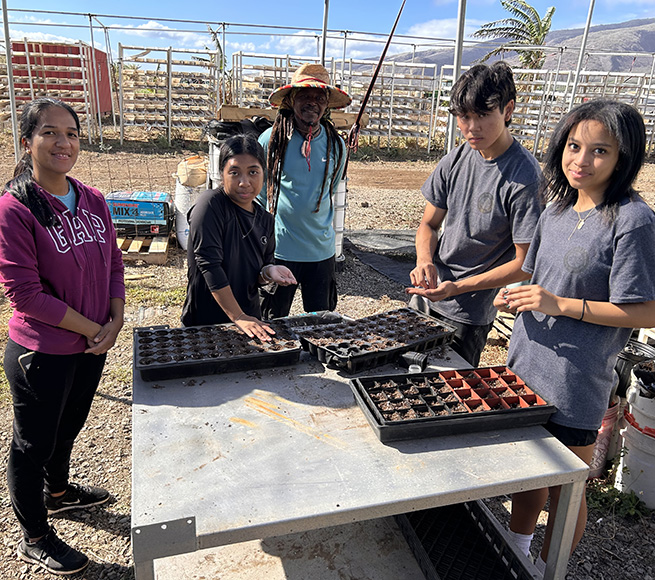
Re-Landscape Hawaiʻi is the native plant nursery of the Living Pono Project. We keep an ongoing inventory of native Hawaiian, culturally significant, drought-tolerant, fire-resilient and restoration species. And when a project needs something that inventory cannot cover, we grow it on contract, specifically for that project.
That means setting aside production space and raising a crop for your project alone. Together we agree the species, the quantities, where the seed comes from, the container size and when you need them. Then we grow it.
You are not shopping. You are commissioning.
When It Makes Sense
Most people come to us for one of a few reasons.
A species nobody stocks. Native plants outside standard nursery inventory, including uncommon, culturally significant, rare and difficult-to-propagate species.
Restoration-scale quantities. Numbers well beyond what the market carries, grown as uniform cohorts.
Plants from a particular place. Material traced to a specific island, watershed, ahupuaʻa or elevation, because provenance changes the outcome.
Your own seed. Seeds, cuttings or divisions you have collected and want grown out properly.
A date you have to hit. Plants ready for a planting season or a construction schedule, in the container size the site needs.
One thing worth knowing early: native plants grow on biological timelines, not project timelines. A crop can take three months or it can take two years. **The earlier we talk, the more we can commit to.
How It Works
Tell us about your project.
Species, quantities, timing, and where the plants are headed.
We build your plant schedule.
Species, quantities, container sizes, provenance, pricing and an estimated ready date.
A deposit reserves your space.
Fifty percent, which holds production capacity for your crop.
We Grow
You hear from us if anything changes along the way.
Inspection, then pickup or delivery.
Every crop is inspected for pests and disease before it leaves the nursery.
Frequently Asked Questions
How long does it take
Anywhere from three months to two years or longer, depending on the species, how it propagates, seed availability, the growing season, container size and the finished size you need. We give you our best professional estimate at the start, and we are honest that it is an estimate. Plants do not sign up to dates.
Can you grow plants from a specific place?
Yes, and for restoration work it often matters as much as the species itself. We can source to island, moku, ahupuaʻa, watershed, elevation, habitat, collection site or parent population. We keep the propagation and collection records for your crop, and once we have agreed a source we will not substitute material from somewhere else.
Can I supply my own seeds or cuttings?
Yes. You will need to confirm the material was lawfully obtained and that any landowner permissions or collection permits are in place. Because seed varies in age, viability and dormancy, we cannot guarantee germination rates or final plant counts from client-supplied material, but we will tell you early if propagation is not going well.
What deposit do you require?
Fifty percent on signing, before production begins. It reserves nursery capacity and covers seed, containers, media, labour and production space. It becomes non-refundable once production starts, because contract-grown plants are raised for one project and usually cannot be resold.
When is the balance due?
At or before pickup or delivery. For large or multi-year contracts we can set milestone payments instead.
What happens if my project is delayed?
You have a 30 day grace period after the scheduled pickup date. Beyond that we charge 4% per month of the value of plants still held, up to a standard maximum of 90 days. Repotting and extra maintenance caused by a delay are billed separately.
How do you prevent spreading pests?
Every contract-grown crop is inspected before it leaves the nursery for Little Fire Ant, Coqui Frog, Coconut Rhinoceros Beetle, invasive weeds, snails and slugs, and visible signs of pests or disease. Little Fire Ant testing is available when a project, agency, funder or receiving property requires it. Inspection reduces risk but cannot be an absolute guarantee.
Will all the plants look the same?
No, and that is normal. Differences in height, branching, leaf colour, form and flowering are what living material does. They are not defects. If your project needs specific minimum heights, calipers or canopy dimensions, tell us up front and we will write them into your plant schedule.
Do you deliver?
Client pickup and nursery delivery are both options. We will confirm which works for your project when we build your quote.
Do I have to sign the agreement to get a quote?
No. Ask for a quote first. If you go ahead, your plant schedule becomes Exhibit A of the growing agreement.
Request a Quote
Tell us what you are planting and we will come back with a plant schedule and a realistic timeline. Restoration, landscaping, cultural, agricultural, mitigation, conservation or revegetation. If it involves native plants and a plan, we would like to hear about it.